
No products in the cart.

Want Bold Leadership in the Era of AI?
Stop Optimizing The Status Quo
In a 1963 Harvard Business Review article titled Managing for Business Effectiveness, Peter Drucker wrote, “There is surely nothing quite so useless as doing with great efficiency what should not be done at all.” Today, we are witnessing one of the greatest business leadership failures in recent decades, and AI is at the center of it.
Business executives are asking how AI can enhance productivity, make processes more efficient, and, as a result, cut costs by reducing their workforce. AI isn’t driving these decisions. It’s being used as a thinly veiled scapegoat to justify them. Companies are using the AI narrative as cover for cleaning up their overhiring decisions and years of corporate bloat without fundamentally changing what work gets done or how value is created.
These behaviors are a reflection of a deeper mindset issue at play: leaders are focused on the wrong side of the AI value equation. In an age of cognitive abundance, productivity isn’t about reducing inputs; it’s about scaling valuable outputs. Yet, most organizational leaders are fixated on shrinking the denominator rather than expanding the numerator.
What’s interesting, though, is that history proves we’ve been here before, yet it appears we haven’t learned much. We can look back to the transition from steam power to electric power in factories during the late 19th and early 20th centuries to see a similar phenomenon to what we’re experiencing with AI. Initially, factories adopted electric power by simply replacing their central steam engines with electric motors, a process known as “straightforward electrification,” which failed to leverage the full transformative potential of electricity.
This direct substitution resulted in only marginal improvements in productivity and efficiency because the operational layout and workflow processes remained constrained by the legacy of steam power designs. The real transformation occurred when factories began to exploit the potential for decentralization that electric power offered. This shift enabled manufacturers to organize machines and workers more effectively, leading to the development of assembly lines and mass production techniques, notably exemplified by Ford Motor Company’s innovations.
Starting in 1913, Ford used electrically powered machinery and a moving assembly line where the parts were moved to each worker who performed a specific task, which reduced chassis assembly time from 12.5 hours to ultimately 1 hour 33 minutes. This step-change in productivity enabled Ford to make the Model T affordable for a much broader segment of the American public, massively expanding its customer base, and exemplifying the truly transformative power of electric energy in manufacturing.
How Professional Services Leaders Are Missing the Mark with AI Today
In 2026, it’s AI, not electric power, that represents the latest technological advancement with the potential of doing for knowledge work what electricity did for manufacturing. As more professional services work becomes automated, the relative importance of human leadership and judgment increases rather than decreases.
The real opportunity with AI lies in a leader’s ability to step back and shift the focus away from optimizing current work tasks or reducing headcount to radically rearchitecting their “factory floor.” This requires a fundamentally different mindset that asks, “What massive client value should we create with an abundance of cognition?”
The New Leadership Profile in the Era of AI
What we know to be true of the past and the future is that effective leadership needs to be highly contextual. And if the only constant is change, and the rate of change is increasing because of AI, it means it’s much more important to deepen certain qualities as a leader.
What is emerging is not an entirely new set of leadership characteristics, but a greater emphasis on those that enable leaders to adapt, act, and create value in real time. For today’s leaders to remain relevant and future-ready, they need to embody the following traits and tendencies.
Meaning Makers – Providing Clarity in Ambiguity
Leadership has evolved alongside the nature of work itself. For much of human history, value was created through physical effort—muscle. As machines replaced human labor, leadership shifted toward the application of intellect, where strategy, analysis, and problem-solving became the primary drivers of performance. Over time, organizations optimized around this model, elevating those who could think faster, analyze deeper, and process more information. Today, however, that paradigm is being disrupted once again. As AI drives the cost of cognition toward zero, the central challenge is no longer a lack of information or analytical capability, but an overabundance of both.
In this new context, leadership is evolving from thinking to meaning-making. Effective leaders are no longer differentiated by their ability to generate analysis, but by their ability to interpret it. When a machine can generate thousands of potential solutions in seconds, the leader who can exercise judgment and select the right path becomes the source of value. Rather than simply solving predefined problems, these leaders define which problems are worth solving in the first place, bringing clarity and direction in environments where both are increasingly scarce.
Advisor–Doers – Solution and Outcome Oriented
Four business professionals sit around a table covered in a white tablecloth, enjoying a meal together. While silverware clinks on plates, one of them suddenly starts choking.
While the other three look around at each other, one finally speaks up and says, “Hey, isn’t Jacobson choking?”
Another of the three seems to take a moment to consider the situation, then looks up and remarks, “I’d definitely say Jacobson is choking.”
Meanwhile, the one choking, who we presume to be Jacobson, continues choking. No one takes action to help.
The first speaks up again, “I know exactly what to do…” He inches closer to the choking Jacobson, still doing nothing to assist him. “It’s called the Heimlich maneuver. You make a ball, stand behind the guy and pull, hard. The action on the solar plexus (he leans over and points to the chest of Jacobson, still choking) expels the food.”
While the three continue to observe and explain the best action plan to help the choking man, a waiter walks over, quickly addresses the situation and performs the Heimlich on Jacobson. The food is dislodged and the man regains his breath.
“Less talk. Make it happen,” is heard through a voiceover as the Royal Bank of Scotland logo appears at the end of the TV commercial.
Historically, many leaders in professional services have built careers on providing expert advice, guidance, and recommendations. While these insights and expertise remain important, they are no longer sufficient on their own. Increasingly, leaders are expected to demonstrate the ability to translate ideas into tangible results. It’s no longer enough to armchair quarterback from the sidelines.
Today’s leaders need to take the approach of demonstrating and teaching the capabilities clients need to deliver results. We call these leaders Advisor-Doers and it’s these leaders, the ones who are able to step out of the boardroom and onto the factory floor, that will thrive in the age of AI.
In this new context, leadership is evolving from thinking to meaning-making. Effective leaders are no longer differentiated by their ability to generate analysis, but by their ability to interpret it. When a machine can generate thousands of potential solutions in seconds, the leader who can exercise judgment and select the right path becomes the source of value. Rather than simply solving predefined problems, these leaders define which problems are worth solving in the first place, bringing clarity and direction in environments where both are increasingly scarce.
Low Ego, High Adaptability – Disrupt Yourself Before You’re Disrupted
“If you don’t take change by the hand, it will take you by the throat.” – Winston Churchill
As the speed of transformation is both rapid and continuous, effective leaders will be the ones who are willing to reinvent themselves, their teams, and their business on a consistent basis. Leaders who are overly attached to past success models or established ways of working often struggle to adapt when conditions shift. Simply put, they let their ego get in the way of evolution.
In contrast, leaders with a high degree of humility are more open to new ideas and more willing to challenge their own assumptions. They recognize that the approaches that drove success in the past may not be sufficient in the future. They disrupt themselves before they get disrupted. This mindset enables them to experiment, fail, learn, and adjust more quickly than their peers.
There is also an inherent tension in this dynamic. Success can reinforce the very behaviors that need to change, making it more difficult for established leaders to adapt. This is where low ego comes into play. Leaders in the age of AI need to embody Marshall Goldsmith’s remark that “What got you here won’t get you there.” and recognize that current success is not a predictor of future results.
Fast Movers – Bias Toward Action
We’re experiencing in real time how the pace of change is no longer linear; it’s compounding. Analysis that once took weeks can now be completed in minutes, and information that once required extensive teams to generate can now be produced instantly. While accessing more information seems beneficial, it introduces a new risk as leaders can quickly find themselves trapped in cycles of over-analysis, waiting for more data, more certainty, or a clearer signal before acting. In reality, the window for advantage is shrinking, and the cost of delay is increasing.
As a result, effective leaders demonstrate a clear bias for action. They recognize that progress is driven through iteration, not perfection, and that real insight is often generated through execution rather than planning. These leaders are willing to test ideas, learn in motion, and adjust based on feedback from the market or the organization. By moving early and learning quickly, they create momentum and are able to turn ambiguity into action while others remain stuck in analysis-paralysis.
How Do You Know If Your Leaders Have These Qualities?
Recognizing the conceptual importance of these leadership traits is one thing; identifying them within your organization is another. Most firms still rely heavily on intuition—experienced leaders trusting their gut to assess talent based on pattern recognition and past success. While that approach may work in isolated cases, it is biased and breaks down at scale, particularly in environments where the definition of leadership success is shifting.
To build a more reliable understanding of leadership effectiveness, organizations must adopt a more structured and data-driven approach. This begins with defining a Leadership Success Profile that reflects what “great” looks like in the context of where the business is going, not where it has been. That profile shouldn’t be built from a single input. Instead, it requires a multi-factor assessment that brings together several distinct but complementary sources of insight to create a more complete and actionable view of leadership potential.
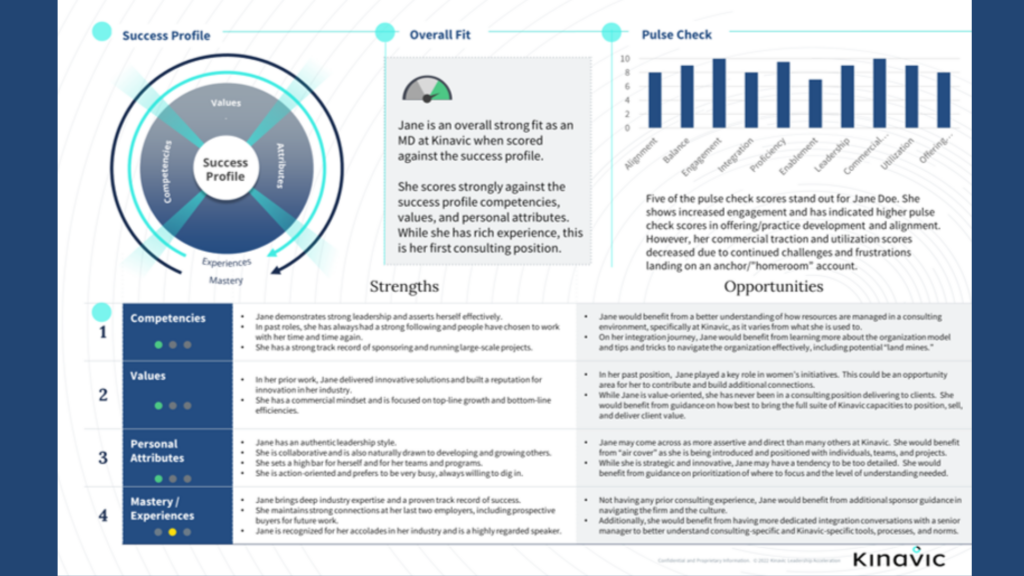
At the foundation of Kinavic’s approach is psychometric assessment, such as the Hogan Personality Assessment, which provides a baseline understanding of personality traits, leadership tendencies, and potential derailers. Layered on top of that is the Verity Leadership Assessment ℠, which draws on a proprietary database of proven leaders in similar professional services environments to identify patterns associated with success.
These data-driven inputs are then combined with a contextual understanding of the organization itself—its strategy, culture, incentives, and the specific outcomes it needs to achieve now and in the future.
Finally, structured interviews should be used to validate and deepen these insights, ensuring that what is measured aligns with how leaders actually behave in practice. While many alternatives in the market rely on one of these components in isolation, this multi-factor approach provides a more rigorous and holistic view. The result is a Leadership Success Profile that is not only descriptive, but predictive. It’s grounded in data, tailored to context, and directly tied to business outcomes.
How Do You Produce More of These Leaders?
Developing this type of leadership capability can’t be addressed through isolated initiatives or one-time interventions. Many organizations attempt to solve the problem through hiring, training programs, or leadership workshops, but these efforts are often disconnected from one another and, as a result, they fail to produce sustained impact.
What is required instead is a systematic and integrated approach to leadership development—we refer to it as an Integrated Leadership Performance System. Importantly, this system must be anchored in future success criteria rather than historical performance.
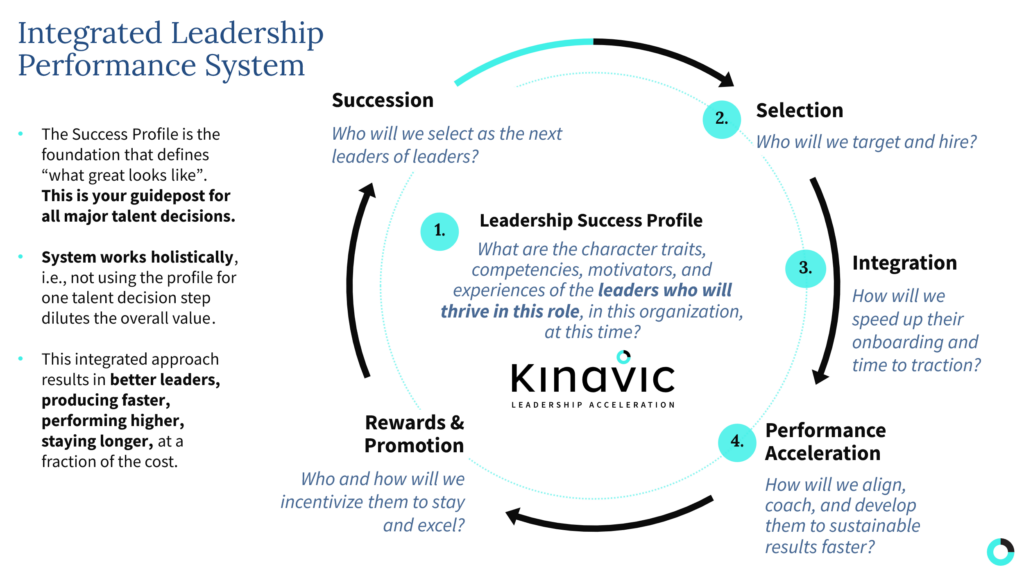
At the center of this approach is the Leadership Success Profile, which serves as the foundation for all talent decisions. This profile should be specific to the role, the organization, and the current business context. It should define the character traits, competencies, motivators, and experiences associated with high performance, and answer a fundamental question: who is most likely to succeed in this role at this point in time?
Once defined, the profile must be applied consistently across the entire leadership lifecycle.
This includes:
Succession planning – Who will you target and select as the next leaders of leaders?
Selection – Who will you target and hire?
Integration – How will you speed up their onboarding and time to traction?
Performance acceleration – How will we align, coach, and develop leaders to sustainable greatness faster?
Rewards and promotion – How will we incentivize leaders to stay and excel?
The effectiveness of this system depends on its consistency. Applying the profile in one area but not others reduce its overall impact and limits the organization’s ability to drive meaningful change. In practice, organizations often struggle not because they lack insight into leadership, but because they fail to apply that insight rigorously and consistently across the system.
Finally, it is important to recognize that leadership requirements will continue to evolve as business conditions change. As a result, Leadership Success Profiles should be revisited and updated on a regular basis, typically every two to three years. This ensures that the organization remains aligned with its strategic priorities and external environment.
Closing Thought
If you’re thinking: “Didn’t these leadership qualities matter before?” The answer is, “Yes, they did.” The difference is not that these traits are new, but that the context has changed in a way that makes them far more important.
Leadership has always been contextual, but the context is now moving faster than ever. The leaders who succeed will be those who can adapt as quickly as the conditions around them change, learning by doing and adjusting in real time. These qualities may have contributed to success in the past, but in the age of AI, they determine whether a leader—and ultimately the organization—can continue to reinvent themselves and deliver outsized performance and results.

Nate Boaz
Nate is a Senior Partner and Co-Founder at Kinavic, where he brings a wealth of leadership performance experience from his time at McKinsey, Accenture, Microsoft, and the Marine Corps.

