
No products in the cart.

Planning to Add More Partners? Why Profit Per Partner Matters More Than Headcount & How to Raise It
By Angela Navarro & Nate Boaz
A firm we know recently spent seven figures to lure a lateral Partner away from another consulting firm.
Add up what it takes to bring someone like that over. A search fee of roughly $200k–$300k — call it 20 to 30% of comp. A signing bonus of $1 million. A catch-up equity grant of another $1 million to make them whole.
That’s about $2.3 million spent before the new Partner has done a single day of work.
Then comes the job itself: guaranteed compensation of $2 to $3 million for the first year.
The target they were assigned? $5 million.
In their first year, they booked $500,000 in revenue. Uh oh.
This is a recurring problem we’re seeing across consulting firms and the broader professional services landscape today. The expectations placed on Partners and the results aren’t lining up. And, by the way, this isn’t just a lateral Partner hiring issue.
Why bigger isn’t the same as more profitable.
Every firm is under pressure to grow, and private equity’s move into professional services has only raised the stakes higher. We’re seeing more capital come in, more expectations around growth, and on shorter time horizons.
Firms are responding the way the industry always has: by adding Partners. Hire them, promote them, and acquire them. Stack the pyramid higher and continue to grow revenue.
But growth alone has never really been the goal. Profitable growth is.
And the way most firms buy growth is also working against the one number that tells you whether your firm is getting healthier or just getting bigger: Profit Per Partner.
Profit Per Partner: The number that really matters.
The math behind Profit Per Partner is very simple: Profit Per Partner = Firm Profits / The # of Equity Partners.
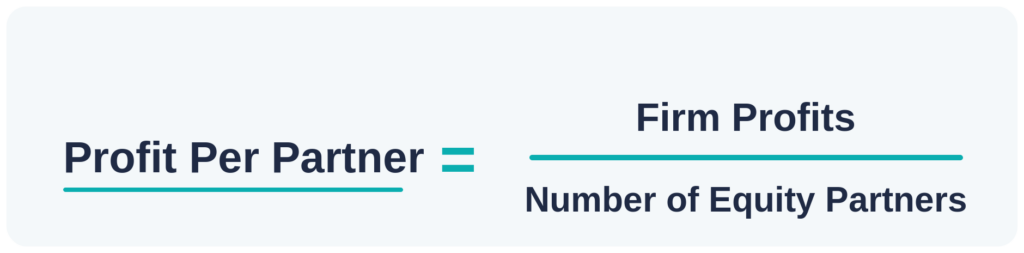
To raise Profit Per Partner, profits have to grow faster than the Partner count.
That’s why the approach of “just add more Partners” does the opposite, because it’s dilutive growth. External hires or acqui-hires move the denominator immediately (and at a cost premium) while firms hope that the numerator catches up in the form of revenue down the road. Spoiler alert: it often doesn’t.
That future revenue? It typically ramps over 18 to 36 months, and about 80% of the time, the book they promised doesn’t arrive within the expected timeframe.
So you underwrote a $5 million producer, yet by year one or two you’re carrying a $2 million one.
That’s dilutive revenue. The top line grows and Profit Per Partner falls. You’ve made the firm bigger and less profitable at the same time.
The three ways to raise Profit Per Partner:
Your choices are:
- Fewer Partners, same revenue. Nobody wants to be cut, and the politics behind this approach will be brutal and demoralizing.
- Lower cost per Partner. This is just a race to the bottom in the most competitive talent market in memory. We all know that’s not a winning long-term strategy.
- Increase Partner productivity. This is the golden ticket, because it raises Profit Per Partner without the political and morale pain points.
The choice here is pretty obvious. So then the question becomes:
How do you increase Partner productivity? Enter Performance Acceleration.
Here’s where most firms go wrong: they assume “more productive” means handing a Partner a bigger target.
But a number on a spreadsheet doesn’t change behavior. Different Partners are wired differently (different motivators, different derailers) and a broad-brush target applied to a deeply individual problem just produces a frustrated Partner, not a more productive one.
The work of leadership is getting people comfortable being uncomfortable: taking a Partner content selling $1 million and helping them get to $2 million. That doesn’t happen by simply shifting the number or bringing in a motivational speaker. Too many leadership development initiatives are performative, not performance-based. They’re built to inspire people rather than change the behavior that drives results.
Changing results, by using data and coaching to change the habits and mindsets that produce them, is the foundation of Performance Acceleration.
The problem isn't who you added or promoted. It’s what you do next.
And let’s be clear about what we’re not saying. We’re not saying stop hiring. We’re not naive to suggest that it’s likely to meet your growth metrics simply by promoting from within.
To hit the necessary growth metrics, firms have to do ALL three things: promote from within, hire laterally, and acquire. That’s the reality. The problem was never bringing people in. The problem occurs with what happens next.
Whatever door a Partner walks through, you should be asking: “What are we doing to help them integrate, achieve, and get traction faster?” That’s Performance Acceleration in a nutshell, and the firms that invest in these systems are the ones that make Partners more profitable.
That investment shows up in three places:
1) Newly Promoted & Existing Partners - Your Partners stopped developing the day they made Partner.
Start here because it’s the biggest pool and the most neglected.
Ask a room of senior Partners when they last had formal leadership development. You’ll hear “ten years ago, when I was a senior manager.”
Leaders don’t get promoted out of the need to keep learning.
These are your most expensive assets, and most are running at a fraction of their ceiling. As Marshall Goldsmith put it, what got you here won’t get you there. So what it takes to reach Partner and what it takes to succeed in the role requires a different muscle that needs to be developed.
And the economics favor them. Internally promoted Partners are 3x less likely to fail or leave than lateral hires because they already know the culture, the clients, and how the firm goes to market. At one global professional services firm we worked with, a structured Partner Acceleration and Development program flipped a 58% new Partner attrition rate in their first 24 months to a 90% retention rate.
Investing in the Partners you already have is the most accretive move a firm can make. The cost to acquire them is zero, and every additional dollar they produce flows straight to Profit Per Partner.
2) Lateral Partners - The same job at a different firm is not the same job.
Lateral hires (direct admits) are the firm’s biggest bets. They’re expensive, they’re senior, and they’re recruited because they bring something the firm needs more of: a network, a book, a capability.
But performance doesn’t transfer as cleanly as firms assume because credentials aren’t conduct. Our own numbers tell the story: only 10 to 20% of lateral Partner hires successfully integrate and hit their targets within the expected timeframe. Half leave within two to three years — and of those who stay, nearly two-thirds still miss their numbers. Hire 20 lateral Partners, and you’re left with two or three who both stay and perform.
The fix isn’t paying more on the front end. It’s compressing Time to Traction once they’re hired by orienting, integrating, and accelerating them deliberately.
Take a prominent consulting firm we worked with. Its Direct Admit Partners were ramping slowly, with attrition running at 50%. We compressed their measured Time to Traction from 15–18 months down to 9–12 months. The new Partners landed in the top 20% of their peer group with 15% year-over-year portfolio growth, and all of them were still in role or promoted at the three-year mark.
From 50% attrition to 100% retention at three years — the same hires but backed by a different system.
3) Acquired Partners - You diligence the financials but skip diligence on the asset that delivers the return.
When a firm acquires another firm, or a PE platform brings several together in a rollup, it runs exhaustive diligence on the financials, the contracts, the technology.
Yet very little diligence is performed on the asset that will actually deliver the return: the Partners.
That’s backwards. In a professional services firm, you’re not buying IP or a balance sheet. You’re buying people who carry numbers.
A mediocre team can sink an excellent investment. An excellent team can rescue a mediocre one.
Diligence the talent before you buy, with the same rigor you bring to the financials. Then accelerate them after you close. We made the full case for that in our piece on leadership talent diligence.
Skip it and the integration math turns ugly fast. Across mergers, leadership turnover routinely runs near half in the first year, and higher by year three.
Don’t just add Partners. Increase Profit Per Partner by accelerating the ones you promote, hire, and acquire.
These aren’t three different problems. They’re one discipline (Performance Acceleration) applied to every way a Partner reaches your bench. No matter if you promote, hire, or acquire, deliberate Performance Acceleration programs are the difference-maker between Partners who become accretive and raise Profit Per Partner and those who dilute it.
An accelerated Partner isn’t a cost. It’s the highest-return growth investment you already own.
And Performance Acceleration shouldn’t be a one-off intervention. It’s a system, anchored by a clear definition of what great looks like and applied consistently across the full leadership lifecycle — selection, integration, acceleration, rewards, and succession.
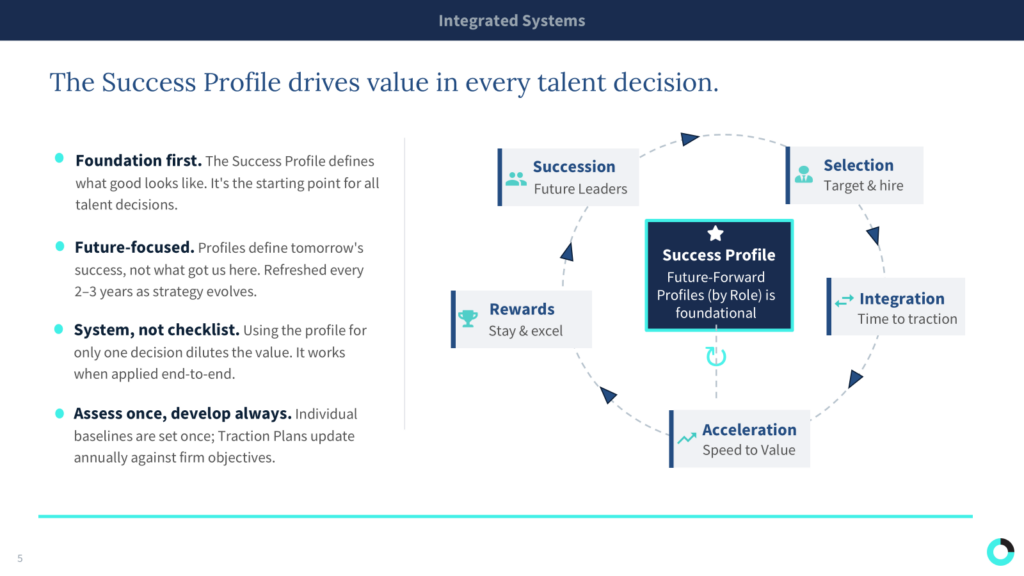
It’s rare to find a firm executing across the entire lifecycle. That’s precisely the opportunity, and we’ll elaborate on it in future pieces.
For now, let’s keep our eye on the prize: raising Profit Per Partner. The most profitable way to grow isn’t to keep running the same lateral Partner hire playbook the way the industry always has. It’s to recognize the failure rates across Partners you hire, acquire, and promote, and to employ Performance Acceleration programs that directly counteract them. That’s the path to profitable growth.

Angela Navarro
Angela is the CEO and Managing Partner at Kinavic Leadership Acceleration, where she leverages over 25 years of experience in human capital management to accelerate the performance of the leaders, teams, and firms that Kinavic serves.



Nate Boaz
Nate is a Senior Partner and Co-Founder at Kinavic, where he brings a wealth of leadership performance experience from his time at McKinsey, Accenture, Microsoft, and the Marine Corps.